NEBRASKA LEGISLATURE
The official site of the Nebraska Unicameral Legislature

The content of these pages is developed and maintained by, and is the sole responsibility of, the individual senator's office and may not reflect the views of the Nebraska Legislature. Questions and comments about the content should be directed to the senator's office at jarch@leg.ne.gov
January 7th, 2026
Thank you for visiting my website. It is an honor to represent the people of the 14th legislative district in the Nebraska Unicameral Legislature.
You’ll find my contact information on the right side of this page, as well as a list of the bills I’ve introduced this session and the committees on which I serve. Please feel free to contact me and my staff about proposed legislation or any other issues you would like to address.
Sincerely,
Sen. John Arch
March 10th, 2025
News Release
FOR IMMEDIATE RELEASE
March 10, 2025
FOR MORE INFORMATION:
Kate Heltzel
Nebraska Legislature
Unicameral Information Office
(402) 471-2788
uio@leg.ne.gov
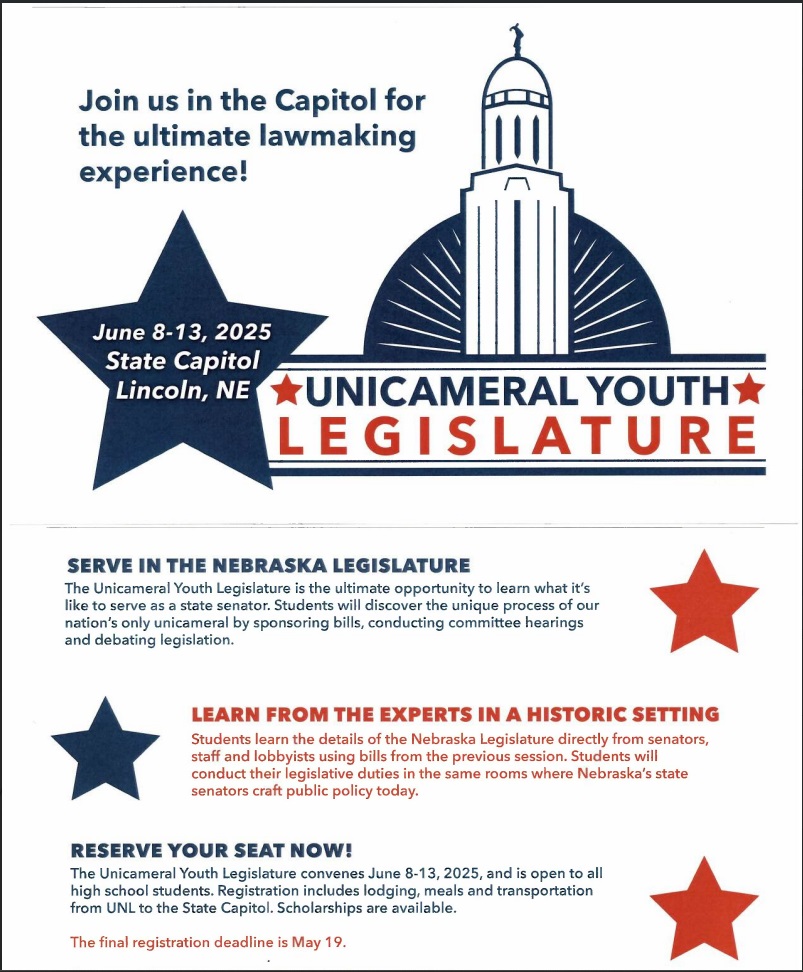
Sen. John Arch invites students to youth legislature
High school students are invited to take on the role of state senators at the Unicameral Youth Legislature June 8-13. At the State Capitol, student senators will sponsor bills, conduct committee hearings, debate legislation and discover the unique process of the nation’s only unicameral.
The Unicameral Youth Legislature gives behind-the-scenes access to students who have an interest in public office, government, politics, law, public policy, debate or public speaking. Students will learn about the inner workings of the Legislature directly from senators and staff.
The Office of the Clerk of the Nebraska Legislature coordinates the Unicameral Youth Legislature. The University of Nebraska–Lincoln’s Extension 4-H Youth Development Office coordinates housing and recreational activities as part of the Big Red Summer Camps program.
To learn more about the program, go to www.NebraskaLegislature.gov/uyl or call (402) 471-2788. The deadline for registration is May 19.
March 25th, 2024
News Release
FOR IMMEDIATE RELEASE
March 25, 2024
FOR MORE INFORMATION:
Kate Heltzel
Nebraska Legislature
Unicameral Information Office
(402) 471-2788
uio@leg.ne.gov
Sen. John Arch invites students to youth legislature
High school students are invited to take on the role of state senators at the Unicameral Youth Legislature June 9-14. At the State Capitol, student senators will sponsor bills, conduct committee hearings, debate legislation and discover the unique process of the nation’s only unicameral.
The Unicameral Youth Legislature gives behind-the-scenes access to students who have an interest in public office, government, politics, law, public policy, debate or public speaking. Students will learn about the inner workings of the Legislature directly from senators and staff.
“Every year, this program gives students an excellent opportunity to learn about our democratic system of government in Nebraska,” according to Senator John Arch. “By participating in the Unicameral Youth Legislature, students learn first-hand of the challenges and rewards experienced by those elected to public service.”
The Office of the Clerk of the Nebraska Legislature coordinates the Unicameral Youth Legislature. The University of Nebraska–Lincoln’s Extension 4-H Youth Development Office coordinates housing and recreational activities as part of the Big Red Summer Camps program.
To learn more about the program, go to www.NebraskaLegislature.gov/uyl or call (402) 471-2788. The deadline for registration is May 20.
May 3rd, 2023
News Release
FOR IMMEDIATE RELEASE
May 3, 2023
FOR MORE INFORMATION:
Kate Heltzel
Nebraska Legislature
Unicameral Information Office
(402) 471-2788
uio@leg.ne.gov
Sen. John Arch invites students to youth legislature
High school students are invited to take on the role of state senators at the Unicameral Youth Legislature June 11-14. At the State Capitol, student senators will sponsor bills, conduct committee hearings, debate legislation and discover the unique process of the nation’s only unicameral.
The Unicameral Youth Legislature gives behind-the-scenes access to students who have an interest in public office, government, politics, law, public policy, debate or public speaking. Students will learn about the inner workings of the Legislature directly from senators and staff.
“The Unicameral Youth Legislature gives participants first-hand experience in Nebraska’s distinctive legislative process,” said Senator John Arch. “Students interested in future public service will gain a valuable lesson about our democratic system of government and will learn about the challenges and rewards of making public policy.”
The Office of the Clerk of the Nebraska Legislature coordinates the Unicameral Youth Legislature. The University of Nebraska–Lincoln’s Extension 4-H Youth Development Office coordinates housing and recreational activities as part of the Big Red Summer Camps program.
To learn more about the program, go to www.NebraskaLegislature.gov/uyl or call (402) 471-2788. The deadline for registration is May 22.
April 6th, 2023
As of this posting, the Legislature is poised to enact significant tax reform resulting in nearly $6 billion dollars going back to taxpayers over the next six years. Robust revenue growth and responsibly restrained spending has resulted in a record amount of available funds in the state’s coffers.
Two bills, LB 754 and LB 243, represent two pieces of a greater overall legislative package designed to make sweeping changes to Nebraska’s tax system and its approach to education funding. The Legislature recently debated and advanced both bills from General File, the first round of debate, with overwhelming support.
LB 754 would result in about $3 billion in tax cuts over six years and is comprised of the following components:
• Reduces gradually the top personal income tax rate from 6.27% to 3.99% by 2027. The corporate tax rate would also be lowered to 3.99% by 2027;
• Phases out the income tax on Social Security, making this retirement income 100% exempt from state taxes by the 2024 tax year;
• Exempts from state income taxes, federal pension benefits received by retirees who don’t receive Social Security;
• Allows for tax credits for parents with children in childcare, for people who donate to childcare programs and for people who operate or work for childcare programs;
• Allows taxpayers to deduct from their federal adjusted growth income either the standard deduction or federal itemized deduction plus the total amount of state and local property taxes paid, whichever is greater;
• Provides for a deduction for corporations for research and experimental expenditures; and
• Establishes a 15-day grace period before out-of-state workers are subject to Nebraska income taxes.
In an effort to mirror the relief provided by the income tax changes, LB 243 would also result in $3 billion in property tax relief by doing the following:
• Increases the amount the state contributes to the property tax credit program from $313 million this year to $560 million by 2029. The fund will continue to increase every year afterwards by the same percentage the statewide total assessed value of property increases from the prior year. While the state doesn’t levy a property tax, the property tax credit program provides for a direct reduction in the amount a property taxpayer owes local governing bodies;
• Removes the growth cap under the Nebraska Property Tax Incentive Act to allow dedicated funds in this program to also grow at the same percentage rate as statewide assessed valuation. Under this program, taxpayers can receive income tax credits to offset the amount of property taxes paid to school districts;
• Limits the annual growth of school revenues to 3%, with exceptions for growth in student population, the number of limited English proficiency learners and poverty students; and
• Eliminates the property tax levy authority for community colleges and provides for state funding with the exception of allowing community colleges to levy property taxes for capital improvements and to fill in gaps should the state not meet its funding obligations.
Nebraska’s corporate and income taxes are not competitive with surrounding states and ever-increasing property taxes are driving people out of our great state. With an unprecedented surplus, Nebraska is in a unique situation and now is the time to resist more government spending and give that money back to the taxpayers.
February 10th, 2023
Today the Legislature is finishing up two weeks of all day committee hearings. Holding full days of hearings is not customary practice but was implemented this session to assess how best to use the Legislature’s limited time. At the beginning of a session, bills are going through the committee process and there are very few items reported to the floor and available for debate. This results in idle time at the start of a session and long days at the end as we scramble to accomplish as much as we can before adjourning for the year. Next week the Legislature will resume its traditional schedule of floor debate in the mornings and public hearings in the afternoon.
While it remains to be seen if this experiment provides more time for valuable floor debate, during these first few weeks of public hearings, the standing committees of the Legislature have heard an unprecedented number of bills. By the end of today, 309 different measures will have been the subject of a hearing, open for public testimony. Some of these hearings brought out hundreds of citizens to the State Capitol, with senators receiving public input through the lunch hour and late into the evenings. In addition to in-person testimony, comments on these bills submitted through the Legislature’s online comment option have totaled more than 9,000. Nebraskans are engaged and the Legislature is listening.
January 20th, 2023
The first session of the 108th Legislature is well-underway, having convened on the first Wednesday after the first Monday in January (January 4th) as required by the Nebraska Constitution. Not only did the start of the session see the swearing in of a new Governor, sixteen new senators joined the Legislature as well. The first three weeks of the session has included the assignment of committees and the election of legislative leadership. I was named the Speaker of the Legislature and am honored to have the opportunity to serve in that role for the next two years. Members have also debated the adoption of the permanent rules of legislative procedure and of course have introduced new legislation. The last day of bill introduction was January 18th and over 800 measures were introduced this session. Next week the fourteen legislative standing committees will begin the process of conducting public hearings on each and every measure introduced. While members of the Legislature always welcome the chance to personally interact with citizens who are able to testify at a public hearing, there is now an option to provide comments on bills online once the bill has been scheduled for a hearing. You can get more information about pending legislation on the Legislature’s webpage: https://nebraskalegislature.gov/ and of course, you are always welcome to contact my office.
April 22nd, 2022
The second session of the One-Hundred and Seventh Legislature has come to an end, with the body adjourning Sine Die on April 20, 2022. The second session, which lasts 60 days, is generally termed the “short” session, while the 90-day sessions occurring in odd-numbered years are known as “long” sessions. Despite this year being a “short” session, it was not short on long nights, challenging subject matter, contentious debates and money.
It can generally be said that there is no such thing as too much money, but after this session, I think you would find many senators willing to debate that statement. With a much better than expected economic recovery from the COVID-19 pandemic and an huge influx of federal funds, the Legislature was in the unusual and difficult position of deciding how those funds should be dealt with. As you can imagine, there was no shortage of suggestions on how the Legislature should tackle this issue.
The Nebraska Constitution requires the state to have a balanced General Fund Budget and determining how to craft the budget is certainly a balancing act. Senators must always keep in mind that these are taxpayers’ dollars and we’ve been elected to protect and spend those dollars wisely. A balance must be found between providing much-needed tax relief, investing in the state’s future growth, ensuring effective and sustainable government programs and maintaining enough of a safety net to be able to successfully weather economic downturns. I think we were able to find that balance with the budget approved this session.
The $9.8 billion budget represents a slight increase in the annual average spending growth from 3% to 3.2%. Much of this growth can be attributed to badly-needed pay increases for state employees that serve in 24-hour facilities such as the penitentiary, and for private providers that serve the state’s most vulnerable Nebraskans including those with developmental disabilities and those in foster care and nursing homes. Years of stagnant reimbursement rates have led to a crisis-level shortage of these critical-care providers resulting in dangerous staffing shortages in our corrections system and a lack of necessary services for those in need. While meeting the needs of the state, the budget also left ample money in the state’s cash reserve fund, which is expected to reach a record-high of $1.3 billion next year. The budget also allowed for the passage of the biggest tax-relief bill in the state’s history.
The Legislature passed LB 873 on April 7th and Governor Ricketts signed it into law on April 13th. The $900 million tax-cut package includes the following provisions:
- Speeds up the phaseout of income taxes on Social Security benefits. Social Security benefits will be 100% exempt from state income taxes beginning in year 2025;
- Phases in a reduction of the state’s top individual income tax rate from the current 6.84% to 5.84% by 2027;
- Phases in a reduction of the corporate income tax rate from the current 7.5% to 5.84% by 2027;
- Establishes a minimum amount dedicated to the refundable income tax credit for property taxes paid to local schools. This year, the state will provide $548 million worth of credits and this amount will continue to grow;
- Establishes a refundable income tax credit for property taxes paid to community colleges. This year the state will provide $50 million worth of credits under this program. This amount will continue to grow as well.
These tax-relief provisions will make Nebraska a more tax-friendly state, particularly for seniors, and will benefit existing Nebraska businesses and help attract new businesses to the state. Combined with the state’s existing Homestead Exemption program and the state’s $313 property tax credit program, the new refundable income tax credit programs for property taxes paid to schools and community colleges, will amount to over $1 billion dollars in state property tax relief. You can find out more about the new income tax credit programs on the Department of Revenue’s webpage: https://revenue.nebraska.gov/.
In addition to balancing the state’s budget while making sure Nebraskans get some of their hard-earned money back, the Legislature also needed to figure out how to allocate $1.4 billion in federal funds granted through the American Rescue Plan Act (ARPA). There was less discretion with respect to the ARPA funds as this money has to be spent by 2026 on COVID-related items or on sectors negatively impacted by the pandemic. Because these are one-time funds, starting new programs that need continuous funding was not an option and federal law specifically prohibited leveraging the funds for tax cuts. Any inappropriate use of these funds is subject to recoupment by the federal government. The ARPA package approved by the Legislature included funding for job training; affordable urban and rural housing; improvements to drinking and wastewater infrastructure; one-time premium pay for health and welfare providers; grants to nonprofit, shovel-ready projects, and incentives for rural health care providers and nursing students.
Of those ARPA funds, I was able to secure a total of $40 million for expanding mental health services through expanded education and facility capacity. Our state is facing a mental-health care crisis with a shortage of service providers and an increase in needed services, particularly among our younger Nebraskans. The COVID-19 pandemic has only exacerbated this problem.
As Chairman of the Health and Human Services committee, some of my other personal accomplishments for this session include: overseeing the passage of legislation that creates a strategic work group to provide direction for a statewide model for child welfare in Nebraska; guiding the passage of a bill that would provide support for family caregivers of children with developmental disabilities and require the state to hire a consultant to evaluate our developmental disabilities system; passing legislation that would modernize Nebraska’s procurement system to an electronic platform and require the state to prepare for revamping the state’s procurement system to mitigate costly contract failures, such as the recent child welfare contract with St. Francis Ministries; and successfully negotiated an agreement between the administration and other senators to ensure passage of a bill that would require the availability of capacity for county jail inmates awaiting competency hearings and would require the Nebraska Department of Health and Human Services to provide Medicaid enrollment assistance to inmates at the state correctional facilities and at county facilities in Douglas, Lancaster and Sarpy prior to leaving incarceration.
Though 2022 was a “short” session, it definitely wasn’t short on activity and a lot of hard decision making. Despite having unexpected amounts of available funds, the Legislature held the line on wasteful spending while expanding the availability of essential services and provided record tax relief while ensuring protection of Nebraska’s fiscal health during the next economic downturn. However there is always room for improvement. Over the legislative interim I will continue to examine how to consistently move our state forward and I always welcome your input. Together we can assure Nebraskans have the opportunity to live the good life for years to come. Please feel free to reach out to me through my office, (402) 471-2730 or by email: jarch@leg.ne.gov.
March 30th, 2022
News Release
FOR IMMEDIATE RELEASE
March 30, 2022
FOR MORE INFORMATION:
Kate Heltzel
Nebraska Legislature
Unicameral Information Office
(402) 471-2788
uio@leg.ne.gov
Sen. John Arch Invites Students to Youth Legislature
High school students are invited to take on the role of state senators at the Unicameral Youth Legislature June 12-15. At the State Capitol, student senators will sponsor bills, conduct committee hearings, debate legislation and discover the unique process of the nation’s only unicameral.
The Unicameral Youth Legislature gives behind-the-scenes access to students who have an interest in public office, government, politics, law, public policy, debate or public speaking. Students will learn about the inner workings of the Legislature directly from senators and staff.
“The Unicameral Youth Legislature gives participants first-hand experience in Nebraska’s distinctive legislative process,” said Senator John Arch. “Students interested in future public service will gain a valuable lesson about our democratic system of government and will learn about the challenges and rewards of making public policy.”
The Office of the Clerk of the Nebraska Legislature coordinates the Unicameral Youth Legislature. The University of Nebraska–Lincoln’s Extension 4-H Youth Development Office coordinates housing and recreational activities as part of the Big Red Summer Camps program.
To learn more about the program, go to www.NebraskaLegislature.gov/uyl or call (402) 471-2788.
The deadline for registration is May 20.
https://nebraskalegislature.gov/education/unicamyouth.php
February 7th, 2022
Greetings,
Most of us know that in the case of an emergency, we can call 911. But did you know there is a number you can call if you are feeling lost, overwhelmed or just need to find available resources? There is. It’s 211.
NE211 Contact Center is a statewide helpline, offering confidential assistance to get Nebraskans in touch with appropriate resources to provide the support needed. And it’s free. The NE211 helpline is manned twenty-four hours a day, seven days a week by professionally trained, caring individuals who can evaluate your situation and recommend the services available to you. NE211 is a one-stop referral service that can provide individuals with information on thousands of resources, including health and human services, legal services, community services, disaster services, aging services and government programs. It is accessible for disabled individuals and can assist individuals in over 150 languages.
In 2018, a total of 69,066 Nebraskans reached out to the NE211 Contact Center for assistance. That number has grown significantly with over 240,000 people seeking help through the center in 2021. The origin of the calls span across the entire state – more than 350 calls came from legislative district 14 alone. Over half of the calls statewide were individuals seeking help with housing needs, followed by utility assistance, employment, health care and food. With the dramatic increase in the volume of calls to the center, operating costs have also increased. The NE211 Contact Center is a public-private partnership operated by the United Way of the Midlands, funded by state funds and private donations.
If you or someone you know is in need of assistance for daily living and don’t know where to turn, call 211. You can find out more about the NE211 Contact Center on its website: https://ne211.org/.
Sen. John Arch
P.O. Box 94604
Lincoln, NE 68509
(402) 471-2730
Email: jarch@leg.ne.gov
- Uncategorized (24)
- Welcome (1)
-
General Affairs
Health and Human Services
Urban Affairs

Streaming video provided by Nebraska Public Media