NEBRASKA LEGISLATURE
The official site of the Nebraska Unicameral Legislature

Sen. Megan Hunt
District 8
The content of these pages is developed and maintained by, and is the sole responsibility of, the individual senator's office and may not reflect the views of the Nebraska Legislature. Questions and comments about the content should be directed to the senator's office at mhunt@leg.ne.gov
July 7, 2022
FOR IMMEDIATE RELEASE
MEDIA CONTACT:
Blair Hess, Director of Communications, CSG
Cassy Ross, Communications Director, Sen. Hunt
Senator Megan Hunt Selected for Prestigious CSG Henry Toll Fellowship
Forty-eight state leaders were chosen for the annual leadership development program
LEXINGTON, Ky. — The Council of State Governments has announced that Senator Megan Hunt has been selected to participate in the 2022 CSG Henry Toll Fellowship. Bringing together 48 individuals representing 32 states from several sectors of state government, the Henry Toll Fellowship is the nation’s premier leadership development program for state government officials.
“It’s an honor to be recognized as a Toll Fellow among so many visionary changemakers across the country,” Nebraska State Senator Megan Hunt said. “We need fighters in all levels of government and policymaking who are hearing and really responding to the needs and concerns of everyday people. I ran for office because I know that we can do more collectively rather than individually. I believe that when we work together, we can build a stronger future for all of us. I am proud to play a role in finding solutions to build a better, more equitable world.”
Each year, the CSG Henry Toll Fellowship brings up to 48 leaders from all three branches of state government to the CSG national headquarters in Lexington, Kentucky, for an intensive, five-day leadership boot camp. The program’s sessions are designed to stimulate personal assessment and growth while providing priceless networking and relationship-building opportunities.
“While the CSG Henry Toll Fellows come from every region of our nation, from both political parties and all three branches of state government, they share one thing in common— they are all people of purpose with a passion for public service,” said CSG Executive Director/CEO David Adkins, a former Kansas state senator and 1993 Toll Fellowship alumnus. “Toll Fellows are selected based on their demonstrated commitment to solve problems, to work collaboratively to get things done, and their belief that state government can and must be a force for good.”
The CSG Henry Toll Fellowship encourages participants to evaluate and adapt the way they interact with each other and the world around them, providing an opportunity unlike any other in the nation. Providing a variety of exercises and sessions, the content of the program is different each year.
There are more than 1,300 graduates of the Toll Fellowship, which began in 1986. Distinguished alumni include five state/territorial house speakers, three sitting state supreme court justices, ten sitting members of Congress, five sitting governors and 200 Toll alumni currently serving as state/territorial legislators.
“Congratulations to the 2022 Toll Fellows for being selected to participate in the premier state government training program in the country,” said Washington state Sen. Sam Hunt, who serves as CSG National Chair for 2022. “As part of a very selective group chosen from state governments across the country, they are in for a rewarding experience. As a former Toll myself, I know they will sharpen their skills in making government more effective.”
For more information on the CSG Henry Toll Fellowship, visit: csg.org/leadership or email leadershipdevelopment@csg.org.
About The Council of State Governments
The Council of State Governments is our nation’s only organization serving all three branches of state government. CSG is a region-based forum that fosters the exchange of insights and ideas to help state officials shape public policy. This offers unparalleled regional, national and international opportunities to network, develop leaders, collaborate and create problem-solving partnerships.
For more information about The Council of State Governments, visit csg.org.
###
May 23rd, 2022
Menstrual Hygiene Product Drive
May 23rd – May 30th
FiveNine – 6105 Maple Street, Omaha


Rally at Omaha City Hall on May 3 in support of abortion rights organized by ACLU of Nebraska, Planned Parenthood, I Be Black Girl and the Women’s Fund. Photo credit: Lyndsay Dunn NOISE
BY. SEN. MEGAN HUNT, LD-8
On May 2, in a truly unprecedented event, a draft decision on the Dobbs v. Jackson U.S. Supreme Court case was leaked to the public. If that opinion becomes final, it will strike down Roe v. Wade and set back fundamental rights in this country by half a century. It’s important to note this is not yet an official ruling—but in Nebraska, we should prepare for the worst.
If this leaked opinion becomes official and Roe is overturned, it will be up to each individual state to determine whether women have the right to an abortion. Under our current law in Nebraska, abortion will remain legal until 20 weeks, with exceptions for life endangerment or severely compromised health.
However, that could change very quickly. Soon after the Supreme Court ruling becomes official, the Nebraska Legislature will convene for a special session and once again, try to pass a total ban on abortion in our state. Though the legislature successfully blocked a bill to ban abortion this year, we didn’t protect the right to abortion in our state for good. We only bought more time for Nebraskans to organize, unite, and strategize for a future in Nebraska without legal abortion care.
“If the Nebraska Legislature does convene a special session to ban abortion, I can promise that anti-choice politicians will have an uphill battle, because they will have to go through me. ”
While the leak of Justice Alito’s opinion was unexpected, the decision to overturn Roe is not. Far right extremists have been intent on eviscerating federal civil rights protections and regressing the country to an era of forced birth for decades. This outcome is no surprise to the people who have long been working for abortion justice outside the realm of electoral politics, because they never counted on the courts or the Democratic Party to save them.
Of course, voting matters. The ideological balance in the Nebraska Legislature is the only reason Nebraska will not immediately have an abortion ban if Roe is overturned. However, repeated calls to simply vote the problem away—which totally disregard voter suppression laws, those who live and pay taxes in Nebraska but do not have the right to vote, and our current cultural hostility to democracy—ignore how effectively the far right has captured the power of so many institutions outside of the electoral process.
There are many things we must do in addition to voting to change our culture and move the needle toward justice. World Health Organization guidance states that individuals in the first trimester of pregnancy can self-manage a medication for an abortion without direct supervision of a health-care provider. We can expect self-managed abortion to grow more prevalent in years to come, and there are a growing number of resources to learn about the research and efficacy of these methods. In addition to increased education around self-managed abortion and legal protections for those who choose this type of care, local funds for abortion services, including legal defense funds, will play a greater role in our public health landscape. This is infrastructure that abortion justice advocates have been building for decades to protect the right to abortion even when legislators fail to.
Abortion is a right. Abortion is health care.
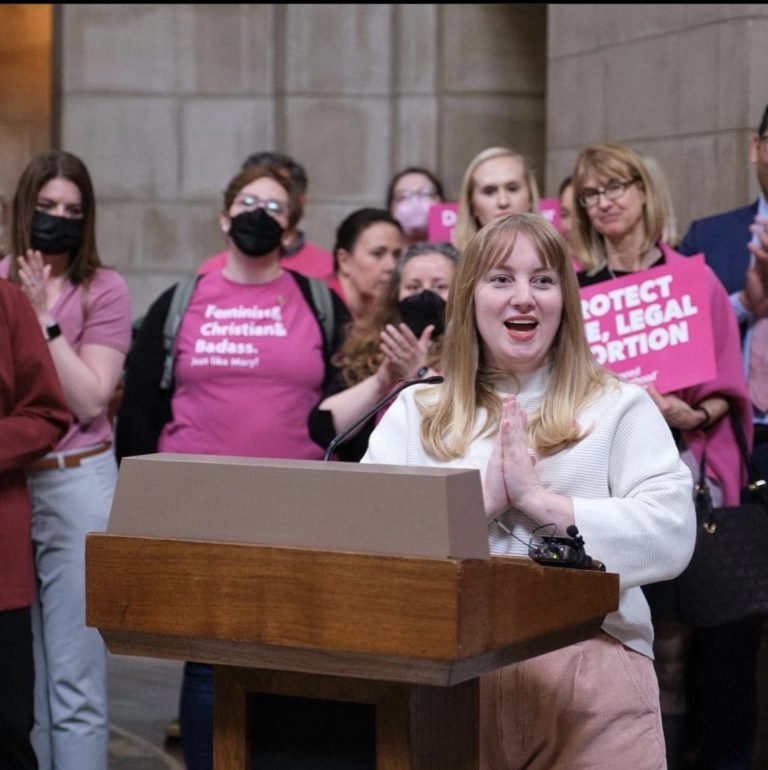
SEN. MEGAN HUNT “And the decision about whether and when to become a parent does not belong to the government.”
And the decision about whether and when to become a parent does not belong to the government. However we personally feel about abortion, individuals should have the option to make these decisions without political interference. If the Nebraska Legislature does convene a special session to ban abortion, I can promise that anti-choice politicians will have an uphill battle, because they will have to go through me. Whatever the outcome is, we must remember that the power is not in the legislature, in Congress, or even in the courts. The power is with us, our communities, and in our commitment to an ethic of compassion and trust in each other.
April 6th, 2022
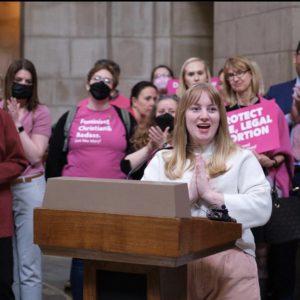
We urged reproductive rights supporters to wear pink at the Nebraska State Capitol while lawmakers debated a bill that bans abortion. I am proud to stand with advocates and my colleagues to support Nebraskans’ rights.

|
|
March 31st, 2022
FOR IMMEDIATE RELEASE: March 28, 2022
Kate Heltzel; Nebraska Legislature, Unicameral Information Office
(402) 471-2788 nio@leg.ne.gov
Senator Megan Hunt Invites Students to the Youth Legislature
High school students are invited to take on the role of state senators at the Unicameral Youth Legislature on June 12-15. At the State Capitol, student senators will sponsor bills, conduct committee hearings, debate legislation and discover the unique process of the nation’s only Unicameral.
The Unicameral Youth Legislature gives behind-the-scenes access to students who have an interest in public office, government, politics, law, public policy, debate, and public speaking. Students will learn about the inner workings of the Legislature directly from senators and staff. Registrants are encouraged to apply for a Greg Adams Civic Scholarship award, which covers the full cost of admission. Applicants must submit a short essay. Other $100 scholarships are also available.
“Civic engagement means a lot of things,” Senator Hunt said. “From volunteering at a phone bank and canvassing neighbors on important issues to census counts and running for office, the range of opportunities to participate in our community is immense. I have no doubt that during students’ time in the Unicameral Youth Legislature, students will learn how to expand their influence and effect on the systems of government that are ultimately here to serve them.”
The Office of the Clerk of the Nebraska Legislature coordinates the Unicameral Youth Legislature. The University of Nebraska-Lincoln’s Extension 4-H Youth Development Office coordinates housing and recreational activities as part of the Big Red Summer Camps program.
To learn more about the program, go to www.NebraskaLegislature.gov/uyl or call (402) 471-2788. The deadline for registration is May 20.
###
March 22nd, 2022
LB 121 Advances to Select File
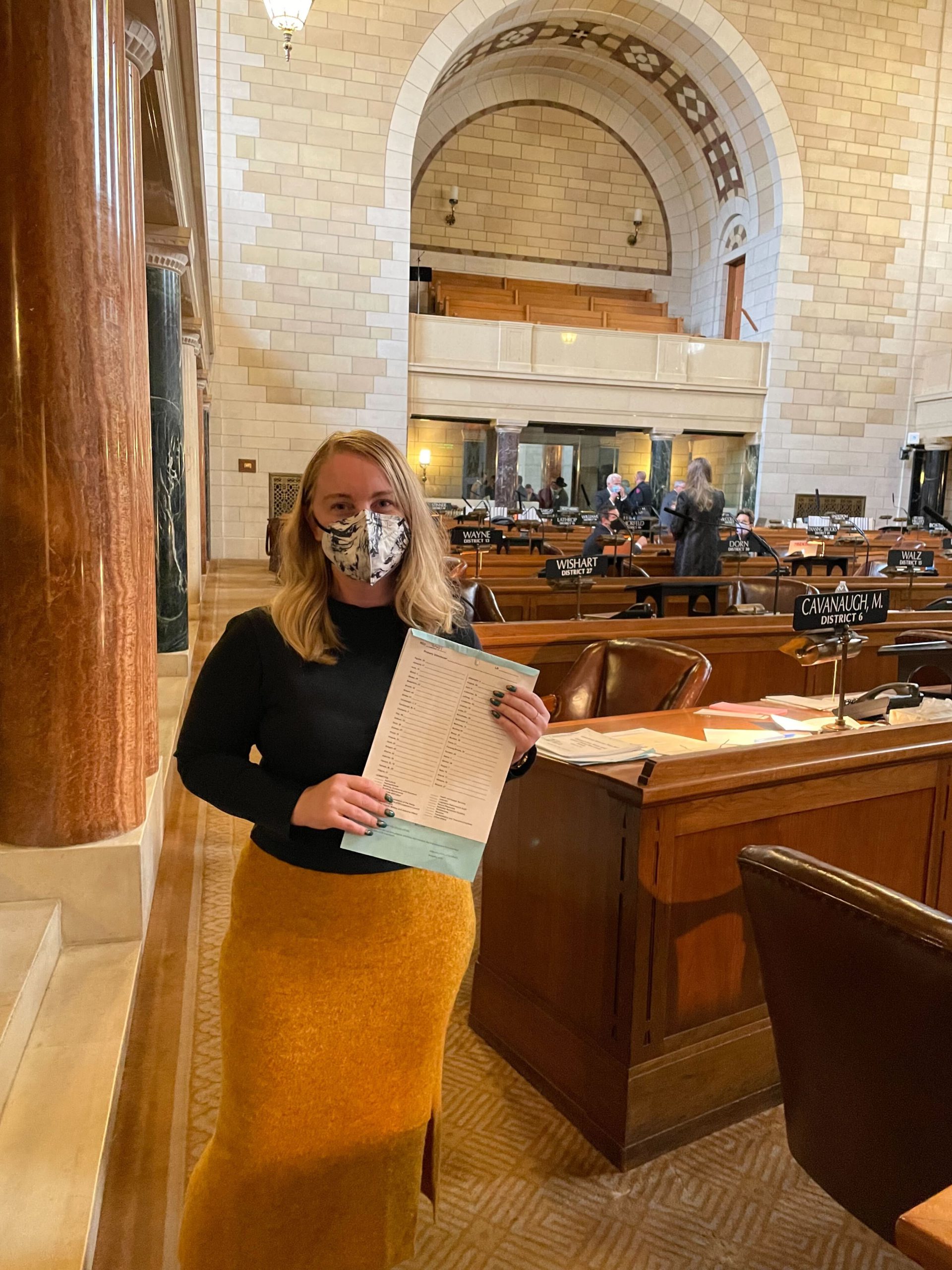
On Tuesday, March 22nd, during floor debate my priority bill LB121 advanced from General File to Select File with 25 yes votes, 17 no votes, and 3 present not voting. Select File is the second stage of debate where a bill is considered by the full legislature. To advance from Select File, a bill must receive 25 yes votes.
LB121 would remove the lifetime Supplemental Nutrition Assistance Program (SNAP) ban that denies food assistance to Nebraskans that have had certain drug-related convictions. Under current statute, an individual with a drug-related conviction is ineligible to receive SNAP benefits for life. This ban is counterproductive to the reintegration of formerly incarcerated individuals.
* vote count from General File, the first stage of debate *
Voting NO: Albrecht, Brewer, Briese, Clements, Erdman, Flood, Halloran, Hansen B., Hilgers, Hughes, Jacobson, Lindstrom, Lowe, Moser, Murman, Sanders, Slama
Present – Not Voting: Aguilar, Arch, Linehan
Voting YES: Blood, Bostar, Brandt, Cavanaugh J., Cavanaugh M., Day, DeBoer, Dorn, Geist, Gragert, Hansen M., Hunt, Kolterman, Lathrop, McCollister, McDonnell, McKinney, Morfeld, Pansing Brooks, Stinner, Vargas, Walz, Wayne, Williams, Wishart
|
|
|
|
|
|
|
|
|
|
Articles about LB121 in the News
|
|
March 17th, 2022
|
|

|
|
|
|
|
|
|
|
|
|
|
|
|
|
|
|
|

|
|

|
|
|
|
|
|
|
|

|
January 25th, 2022
|
|
|
|
|
|
|


|
|
|
|
|
|
|
|
|
|
|
|
|
January 6th, 2022
FOR IMMEDIATE RELEASE Contact: Cassy Ross, Communications Director
Phone: (402) 471-2722
Email: cross@leg.ne.gov
Senator Megan Hunt Introduces Legislative Resolution 269CA to Establish an Independent Redistricting Commission
Lincoln, NE— 1.6.22 — State Senator Megan Hunt introduced LR 269CA today to amend the Nebraska Constitution to establish an independent redistricting commission, to be appointed by the Legislature. If passed, the proposal will be added to the November 2022 ballot for the voters of Nebraska to affirm. Recent redistricting efforts were overshadowed by partisan games and the process largely obscured from public view. Nebraskans deserve for this process to be placed in the hands of people who can take on this responsibility in a transparent and impartial manner.
This proposal would establish a politically balanced nine-member independent citizens commission to set district lines. It would prohibit anyone who has been a lobbyist, elected official, party leader, or candidate in the past five years and their family members from serving on the commission. Members of the Legislature would screen Commission members. The Commission would recommend a plan for district boundaries to the Legislature for approval. This way, the Legislature still plays an oversight role in the process, but there is a citizen arm of checks and balances to make the process fairer. The proposal is modeled after the 2020 Ballot Initiative Petition that was filed, but which did not obtain the necessary signatures to get on the ballot due to the COVID19 pandemic.
“It’s time to infuse more democracy into Nebraska’s redistricting process – and we need to do it while those of us with recent knowledge of the process are still in the body,” Hunt said. “When Nebraskans cast their ballots, they need to know their vote counts and their voice matters. I am committed to ensuring voters can pick their leaders, not the other way around.”
###
January 6th, 2022
FOR IMMEDIATE RELEASE Contact: Cassy Ross, Communications Director
Phone: (402) 471-2722
Email: cross@leg.ne.gov
Senator Megan Hunt Introduces Legislative Bill 835 to Allow 529 NEST College Saving Plans to Pay Student Loans
Lincoln, NE— 1.6.22 — Today, Senator Megan Hunt introduced LB 835 to provide an option that could help relieve student debtors’ loan balances: the 529 NEST college saving plan. Currently, 529 plans allow families to contribute money to an account, which grows on a tax deferred basis and can be withdrawn tax-free if it’s used to pay for qualified education expenses, like tuition or textbooks. In 2019, the federal SECURE Act created new flexibilities for 529 college savings plans, including one that allows these plans to be used to make student loan payments. However, the state’s existing statute prohibits Nebraskans from utilizing the newly granted 529 options. LB 835 will permit 529 planholders to use account assets to pay up to $10,000 in student loans per beneficiary to help.
Data from the Department of Education show nearly a quarter-million Nebraskans have student loan debt, owing $7.7 billion to the federal government as of September 2020. Harmonizing state statute to match federal statute is not only good governance, but provides a small way to help address the rising national student debt crisis. This is good news for parents and grandparents who work and save to set money aside for their child or grandchild’s education. If 529 assets can be used to pay tuition, it makes sense that they can be used to pay student loans for past tuition as well.
“Student debt holds entrepreneurs back from starting businesses, holds families back from buying homes, holds workers back from saving for retirement and holds our economy back,” Hunt said. “It’s time to start looking at realistic ways to address the crushing debt students live most of their lives with. Our economy isn’t money. It’s people. That should be our focus.”
###
Sen. Megan Hunt
P.O. Box 94604
Lincoln, NE 68509
(402) 471-2722
Email: mhunt@leg.ne.gov
- Column (47)
- District Info (4)
- Events (6)
- Opinion (2)
- Press Releases (24)
- Uncategorized (7)
- Welcome (1)
-
Business and Labor
Committee On Committees
Government
Military and Veterans Affairs
Urban Affairs
State-Tribal Relations

Streaming video provided by Nebraska Public Media